
Every month, more than 1,000 tonnes of waste leave Nestlé’s eight South African sites. And since July 2016, no general waste has gone to landfill.
That takes more than a recycling programme. Food and beverage manufacturing calls for a carefully considered approach to Zero Waste To Landfill (ZWTL) – with the right solution for every waste stream, robust controls at every stage, and a clear record of where everything ends up.
From Rejected Chocolate To Reusable Steel Drums: A Case Study In Rethinking Food And Beverage Waste
What more than a decade with South Africa’s food and beverage manufacturers has taught us about turning complex waste streams into measurable results.
Every month, more than 1,000 tonnes of waste leave Nestlé’s eight South African sites. And since July 2016, no general waste has gone to landfill.
That takes more than a recycling programme. Food and beverage manufacturing calls for a carefully considered approach to Zero Waste To Landfill (ZWTL) – with the right solution for every waste stream, robust controls at every stage, and a clear record of where everything ends up. Expired or rejected stock needs to be handled safely, hygiene standards must be maintained, and branded products and packaging require careful management.
WastePlan has managed waste across Nestlé’s national operations for 14 years, covering three sites in Gauteng, three in KwaZulu-Natal and two in the Western Cape. For the past seven years, it has also managed waste at flavour and fragrance manufacturer Firmenich’s two Gauteng sites, where everything from flavourant residues to steel drums is recycled or recovered.
That experience has given WastePlan a detailed understanding of what leaves a food and beverage factory, what can be recovered from it, and what it takes to keep valuable materials in circulation.
ABOUT THE FOOD AND BEVERAGE INDUSTRY
Food and beverage manufacturing generates a remarkably diverse range of waste streams. Alongside cardboard, paper and plastics, a typical site may produce ingredient residues, off-spec product, industrial packaging, process by-products such as boiler ash, and small volumes of hazardous waste. Across Nestlé’s sites alone, WastePlan manages more than 120 separate waste streams.
What makes the sector particularly interesting is the relationship between product, packaging and brand. A carton of expired stock contains several distinct materials: the food inside, the film around it, the box around that, and the pallet underneath. Each may have a different recovery route, and the entire process needs to protect the manufacturer’s brand.
Manufacturers also have different priorities. For some, achieving ZWTL is the primary objective. Others place greater emphasis on cost per tonne, generating rebates or strengthening ESG
reporting. The most effective approach begins by understanding those priorities and designing a solution around them.
THE CHALLENGES
The opportunity in food and beverage manufacturing lies in understanding the detail. Different materials, production processes and commercial priorities call for different solutions.
-
Expired, redundant and off-spec stock
Products may reach their expiry date, be rejected on the production line or become surplus after a recipe or packaging change. Often still sealed in their packaging, they need to be separated safely and hygienically, at scale, so that both product and packaging can be directed to suitable recycling or recovery routes.
-
Specialist food and ingredient streams.
Powders, spices, sauces, fats, oils and flavourants each have potential value and specific handling requirements. Animal feed, for example, can be a valuable recovery route for many food streams. But livestock are sensitive to high levels of sugar and starch, so these products need to be blended in carefully controlled ratios.
-
Returnable industrial packaging
Raw materials arrive in steel and plastic drums, polycans, on pallets and in IBCs (intermediate bulk containers, which are large plastic tanks, usually around 1,000 litres, held in a steel cage). Careful inspection and grading establish which units can be reused, which can be refurbished and which are suitable for recycling.
-
Changing volumes
Waste follows production patterns. A stock-out or formulation change can cause a particular stream to increase sharply, making flexible capacity and multiple recovery routes important.
-
Cost and logistics
Every material needs a commercially workable route. For smaller streams, consolidating compatible materials can reduce transport costs and make recycling or recovery viable.
-
Compliance and reporting
Hazardous containers and chemical residues, landfill restrictions, ISO audits and ESG disclosures to global parent companies all call for accurate, verifiable data. Reliable records underpin credible diversion figures.
-
Brand protection
Branded products and packaging require secure, traceable handling, with clear controls over where materials go and how they are processed.
THE SOLUTION
So, how does WastePlan achieve ZWTL in this demanding environment? Seven practices have proved their value over years of working on the factory floor.
1. Start with what drives the client’s targets
Every engagement begins with a simple question: what does success look like for the client?
For some, ZWTL guides every decision, from selecting the right offtaker for each stream to identifying technologies worth testing. For others, cost per tonne or rebate potential carries greater weight. Understanding these priorities helps WastePlan determine the most appropriate route for each waste stream.
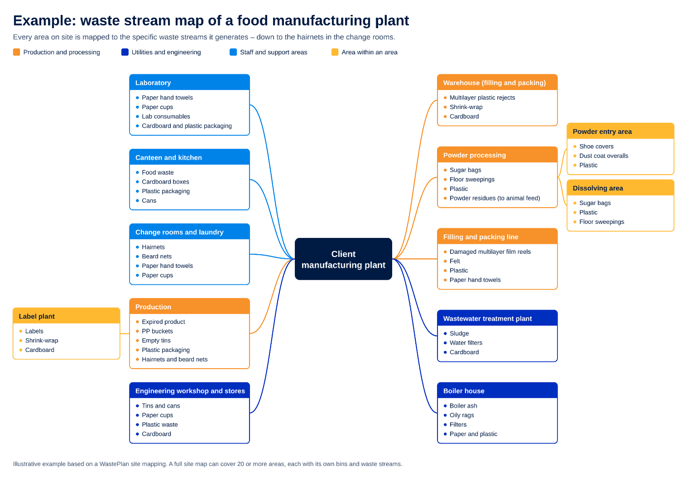
The next step is to understand exactly what each site produces. For smaller clients, a waste audit examines the residual waste leaving the site and identifies opportunities for better recovery. For large, multi-site manufacturers such as Nestlé, WastePlan conducts detailed waste mapping across sites, capturing everything from cardboard cores and coffee grounds to condensed milk and boiler ash.
2. Separate the product from the packaging
Consider a pallet of rejected chocolate bars, still in their wrappers. Separating the product from its packaging creates an opportunity to recover both materials through different routes.
In March 2025, WastePlan’s on-site team began manually depackaging Nestlé’s rejected chocolate. The chocolate now goes to recovery routes such as animal feed, while the wrappers and boxes are sent for recycling. The same care applies to expired baby formula, powders, noodles and spices.
Over a recent two-year period, more than 900 tonnes of rejected chocolate and 270 tonnes of baby formula were recovered. Products are debranded on site as part of the process, helping protect the manufacturer’s brand while enabling more of each load to be put to use.
3. Grade before scrapping
At Firmenich, raw materials arrive in 210-litre steel drums, IBCs, 25-litre polycans and on pallets. Once emptied, each unit is inspected and graded according to its condition. A-grade packaging goes straight back into use, B-grade is refurbished, and C-grade is sold as scrap.
This keeps reusable and refurbishable materials in circulation for longer, while ensuring that each unit follows an appropriate route. Over two years, the process kept almost 7,900 good pallets, around 1,290 A-grade IBCs and more than 2,200 steel drums in circulation.
4. Build resilience with multiple offtakers
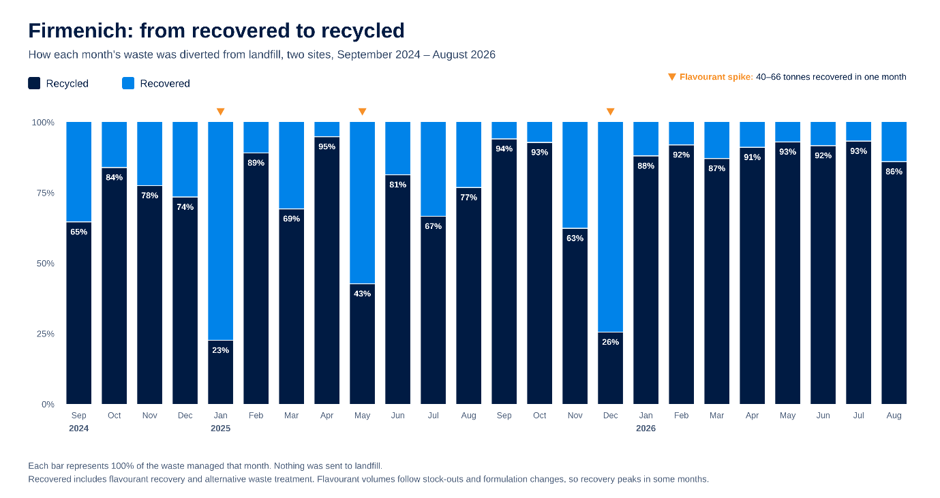
Waste volumes can change dramatically from one month to the next. In December 2025, Firmenich’s flavourant waste reached almost 66 tonnes in a single month. A month later, it was less than half a tonne.
These fluctuations can follow stock-outs and formulation changes. By maintaining more than one approved offtaker for flavourants, WastePlan was able to accommodate the peak without delay, keeping all the material out of landfill.
The same principle applies across critical waste streams. Having alternative approved outlets gives the process flexibility when a facility reaches capacity, closes for maintenance or changes its acceptance criteria. It also helps ensure that materials continue moving towards their intended destinations as production requirements change.
5. Make small streams count
Not every waste stream arrives by the tonne. Firmenich produces around 70 kg of beverage cartons a month, and even less polystyrene. For volumes this small, the key is finding a practical way to bring the material into the recycling or recovery system. WastePlan does this through consolidation, grouping small volumes with compatible materials and sending them to offtakers that accept several streams in one load.
One collection can then accommodate multiple materials, reducing transport costs per tonne and making smaller streams commercially viable. The result is a more comprehensive approach to waste diversion, where even modest volumes have a defined route.
6. Prove every load
Effective waste management depends on knowing where materials go after they leave a site. WastePlan’s trucks are tracked in real time from the moment they leave a client’s premises. For sensitive materials (such as branded or expired product) loads are also photographed as they leave site and again on arrival at WastePlan’s material recovery facility (MRF), giving visual confirmation at both ends of the journey. Every collection is supported by waste manifests and, where relevant, safe disposal certificates on WastePlan’s reporting platform.
The result is a traceable record from collection to final destination, with every kilogram accounted for. Hazardous waste is managed separately under the required licences, and WastePlan is ISO 9001, 14001 and 45001 certified. For manufacturers preparing for an ISO audit or reporting to a global parent company, this provides the evidence behind the diversion figures and supports accurate, verifiable reporting.
7. Keep finding new opportunities
Even on an established site, there is always scope to improve. Regular audits help identify materials that can be separated, recovered or recycled through newly established routes.
In early 2026, more than five years into the Firmenich partnership, audits identified plastic film, sticky plastic, woven bags and printed labels that could be directed away from general waste. Each now has its own recycling or recovery route, adding almost 18 tonnes in the first eight months of 2026 alone.
The lesson is simple: waste mapping establishes the starting point, but ongoing review helps uncover further opportunities as materials, processes and recovery options evolve.
Underpinning it all: the waste hierarchy
Across all seven practices, WastePlan aims to move each stream as high up the waste hierarchy as possible, prioritising reuse and recycling where appropriate.
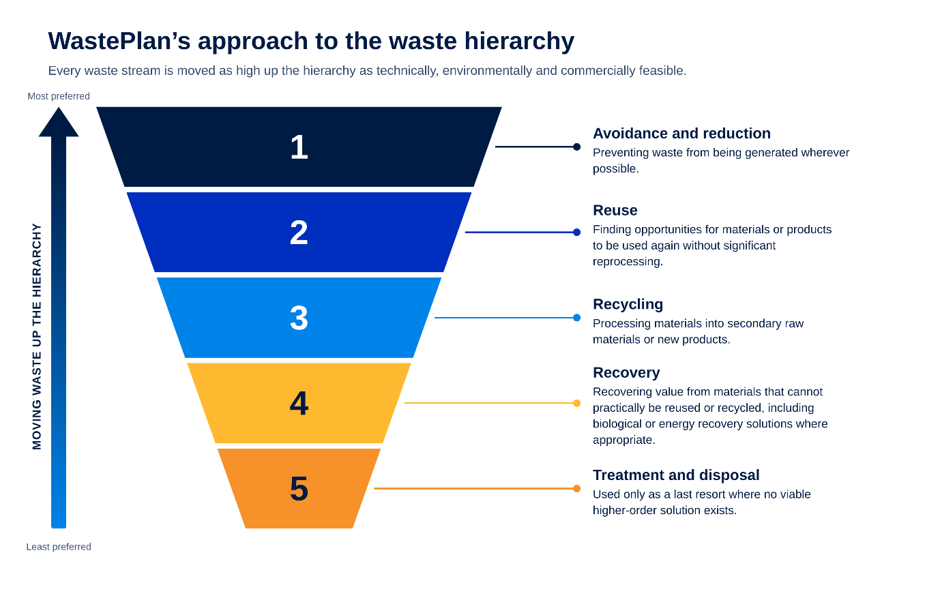
Commercial considerations also matter. The team first looks for outlets that offer a rebate, followed by no-cost and low-cost options, before considering specialist solutions where needed.
Because WastePlan earns most of its revenue from selling the recyclables it collects, its commercial incentives are aligned with those of its clients. The aim is to identify the best practical outcome for each material, balancing environmental performance with commercial value.
THE RESULTS
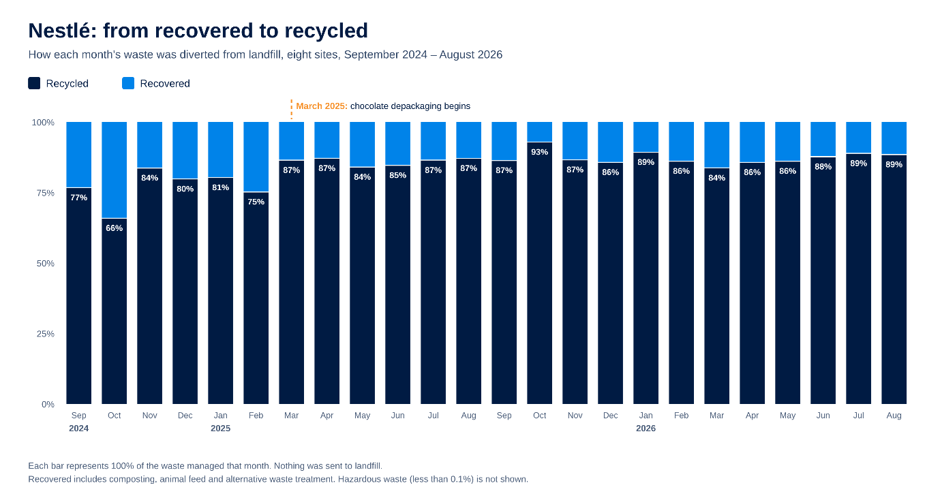
A recent 24-month sample of data, covering September 2024 to August 2026, shows what this approach delivers.
-
Across Nestlé’s eight sites, WastePlan managed more than 25,000 tonnes of waste, with zero sent to landfill. Around 84% of the total waste generated was recycled, and the balance recovered, while less than 10 tonnes of hazardous waste was treated in compliance with requirements.
-
At Firmenich’s two sites, almost 900 tonnes were recycled or recovered, averaging around 37 tonnes a month, again with zero sent to landfill.
The results also show how waste streams can move progressively towards higher-value outcomes.
At Nestlé, the share of waste recycled, rather than recovered, rose from 66% in October 2024 to 87% by March 2025, the month chocolate depackaging began. It has remained between 84% and 93% every month since.
-
At Firmenich, the recycled share increased from 62% in the first year to 75% in the second.
WHAT THE CLIENT HAD TO SAY
Achieving ZWTL in food and beverage manufacturing comes down to getting the details right, stream by stream. That means finding the right recovery route for every material, managing each process carefully and tracking every kilogram. It takes operational expertise, consistency and a partner who keeps looking for ways to improve.
As Chris Ngwendu, Nestlé’s Market SHE Specialist, recently commented:
“WastePlan has consistently provided a dependable and professional service, underpinned by knowledgeable personnel, proactive support, and a constructive approach to continuous improvement. We value their reliability, responsiveness and communication, innovation, as well as their strong health, safety, and environmental focus. We confidently recommend WastePlan as a credible, capable provider of waste management and recycling services.”
Great results start with better questions
With offices, MRFs and on-site teams across Gauteng, KwaZulu-Natal and the Western Cape, WastePlan helps food and beverage manufacturers find smarter ways to manage waste.
Request a free waste gap analysis and discover how much further your operation could go – when nothing goes to waste.